

First There Is a Mountain
Posted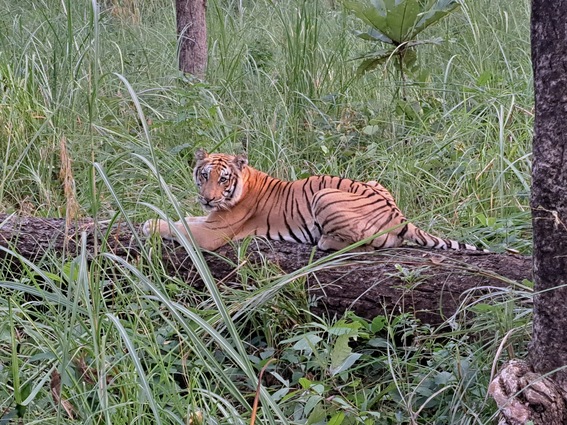
Chitwan was lovely, and a good complement to the rest of the trip. I'm glad we went there instead of doing a second trek in the Annapurnas. We reached the edge of the national park around noon and went for a jungle walk that evening, where we saw a rhino in the distance across the river, along with a handful of birds. For all three days we had the same guide, Bishnu, an expert in the local birds. Tony has been getting into birding, so we chose our lodge because it's run by one of Nepal's top ornithologists.

The next day we did a full-day jeep safari (in Nepal, "jeep" means any rugged four-wheel drive; I've yet to see an actual Jeep on this trip) and saw four more rhinos, scores of spotted deer, two hog deer, a muntjac, a Burmese python, about 20 monkeys (rhesus macaques and Hanuman langurs), five wild boars, lots of peacocks and peahens, a monitor lizard way up in a tree, a big golden spider, and more than 40 species of birds.
The one they missed
Bishnu and our driver were remarkably good at spotting tiny or camouflaged animals while bouncing along in a moving vehicle. I still can't believe they spotted the python, the monitor lizard, or half of those tiny birds.
Chitwan is a lot busier than Bardia, where, last time I was in Nepal, "I got the feeling I was the only tourist in the entire park." Not too busy, but we were rarely alone. On the way back to the lodge, Bishnu decided to take us on one last detour, down a track that few people use, judging by the growth our jeep had to fight through. It was one of the only times all day that there was no one else around. And somehow, Bishnu and the driver went right past a tiger lying on a log in the open, not far from the road.
It was Tony who spotted her and yelled for us to stop and back up. Sure enough, there she was: bright orange, about 33 ft (10 m) from the road.
Whether she recognized the jeep as a vehicle full of humans or just a large, loud animal with a lot of eyes, I don't know, but she didn't seem to care and certainly didn't look threatened. She looked at us, directly at us, then went back to not caring and being majestic. What a boss.
She lay there for another five full minutes (that felt like twenty), then got up and stretched like a cat (even if the pose is called "downward dog"), strolled to a puddle in the road for a drink, and then visited several trees to mark them with her scent. We followed her down the road for a while, and she stayed completely unbothered by us. Finally she turned off the road into the tall grass and was gone in an instant.
Our closest rhino encounter came that night, when we got back from the safari to find one grazing in the ditch beside a hotel at the edge of town.
On our last full day we took a dugout canoe down the Rapti River and saw several crocodiles, both mugger (flat, short snout) and gharial (long, narrow snout), plus more birds. Then a jungle walk turned up even more birds, termite mounds up close, and strangler vines, which Bishnu said always twist to the left.
That night we went to an authentic Tharu restaurant, where I tried their traditional cuisine, including local snails and duck. Luckily I already knew how to eat snails from my time in Vietnam. I've really enjoyed exploring the different traditional cuisines around Nepal. They all share the same basic components (dal, bhat, curries, vegetables, and achar), but each culture, Thakali, Newari, Tharu, and so on, has its own take.
Lumbini
After our detour to Chitwan it was time to get back to the original plan and head to Lumbini, the birthplace of the Buddha and our last stop in Nepal before crossing into India. Lumbini is an interesting place. It's mostly one enormous temple ground, about 3 mi (4.8 km) by 1 mi (1.6 km), that mixes the ancient ruins around the Buddha's birthplace, temples built by nearly every Buddhist nation, and a lot of sprawling, unkempt space. And monkeys. It's an important pilgrimage site in most Buddhist traditions, but luckily it didn't feel busy when we were there, perhaps because the grounds could hold the entire world's Buddhist population at once.
Diwali at point-blank range
We crossed the border from Nepal into India on Laxmi Puja, the main day of Diwali. The crossing itself was mercifully uneventful. The evening was not. I don't know what happens inside homes and temples on Diwali, but out on the street it felt like a mix of Christmas and the Fourth of July in the United States. Homes and buildings were strung with lights, and the fireworks could be seen and heard and felt. Tony and I had thought about going out somewhere to see the lights, but before we'd even left our room it was clear we wouldn't need to: the street right outside our hotel was ground zero for the neighborhood's fireworks. All evening, they rocked our building and scorched our window. The men lighting them (there were no children around) were setting off mortars that sometimes exploded before they'd cleared the roof.
Dharamshala
After our first night in India, we took an overnight train and then a three-hour taxi up to Dharamshala, the seat of the Tibetan government-in-exile and home to both the Dalai Lama and my friends Josh and Dolker and their two-year-old son. The train ride was fairly chill. Perhaps the most interesting part was ordering dinner with the Food on Train app from a restaurant near an upcoming station, and having someone deliver it to our seats when we pulled in. What a time to be alive! We also made friends with Zorawar, a Sikh man who came to sit with us. More on the Sikhs in the next post, after we visit Amritsar, their holiest city and the last stop on our trip.
Hanging out with Josh, Dolker, and their son has been really nice. There's been a lot of home life (talking, cooking, playing games), several walks through the tea fields and rice paddies outside their house, and cold plunges in the nearby river.
We've also made a few outings: to Norbulingka, the Tibetan arts institute; Tsuglagkhang, the main temple, in the complex where the Dalai Lama lives; Men-Tsee-Khang, the Tibetan medicine and astrology institute; and Dolma Ling Nunnery, where Dolker is doing a photography project.
Tony, Josh, and I also did a two-day trek up to Kareri Lake, which was incredibly serene. It had snowed the day before we set out, which made everything extra beautiful and the trail far less busy. Unlike on our Annapurna trek, there was almost no one else on the trail, and very little garbage or burning trash.
It was cold at the top, though; we each slept inside three sleeping bags to stay warm.
The trek gave Josh and me time to continue our ongoing conversation about spirituality, philosophy, and metaphysics. Where we ended up, after bottoming out in the infinite regress of duality and non-duality, was the question of why we make these existential journeys at all. If the scriptures already tell you the answer, and when you finally realize it you end up right back where you started, then where are we trying to go? Maybe it's about the journey after all. Josh has been practicing Dzogchen lately, a Tibetan tradition whose name means "Great Perfection" and which teaches that awakening isn't something you reach but something you recognize. My own path has been drifting in a similar direction.
Then there is
There's an old Zen saying, from a Chinese master named Qingyuan Weixin, about exactly this. Before he studied Zen, mountains were mountains and rivers were rivers. Once he'd gained some insight, mountains were no longer mountains and rivers were no longer rivers. And once he truly understood, mountains were once again mountains, and rivers once again rivers. Donovan turned it into the song I've paired with this post: "First there is a mountain, then there is no mountain, then there is."
It took me a while to get it. The Space Needle is a beautiful part of the Seattle skyline, and the worst place to see it from is inside. Mountains turn out to be similar. Up at Kareri Lake, the lower peaks hid the one we were on completely, and the view from up top was never really about that mountain anyway; it was about everything else. At the top, there is no mountain. The song I paired with my last post asks whether we climb just to reach the top and see the view. Maybe the point is to reach the bottom and see the view anew.
Tony and I started this trip immersed in Hindu culture, with Dashain and Tihar in Nepal and Diwali in India, and now we're surrounded by Tibetan Buddhism. Tomorrow we head to Amritsar, where the Sikhs will be celebrating Gurpurab, one of the holiest days of their year. Perhaps all roads lead to the same place, and you're already there. You don't have to take the hike to see the mountain, but it looks a little different from the bottom once you have.
Soundtrack: There Is a Mountain (Donovan)