

Home for Dashain
Posted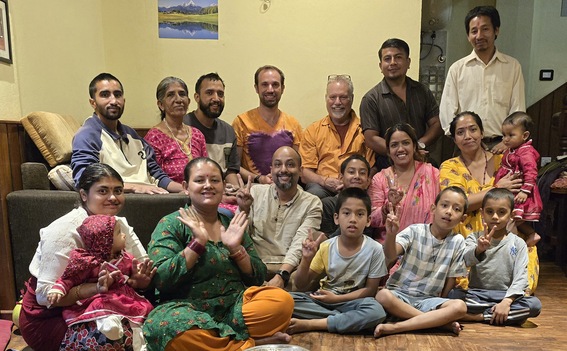
Greetings from Pokhara! My dad, Tony, and I are two weeks into our seven-week trip through Nepal and India, and so far it's going wonderfully. We had a long but manageable flight through Qatar into Kathmandu, with the morning sun lighting up the Himalayas as we made our descent. There we were met at the airport by my old friend Aabhash and his two sons. I met Aabhash in 2013 while couchsurfing and stayed with him at his old place in the heart of Kathmandu, which was destroyed in the 2015 earthquake. His family survived that tragedy but moved to a new house on the eastern side of town. Aabhash had to take his sons to school, so he arranged a taxi to take us to his house, where the rest of his family was waiting.
As long-time readers of this blog know, I've had many harrowing rides in foreign countries, and it takes a lot to move the needle for me. Indeed, I remained calm and collected as our taxi sped through the jumbled streets of Kathmandu, overtaking absolutely every vehicle in our path and pursuing our destination with the fervor of a beagle on a rabbit. We took dozens of taxis during the rest of our time in Kathmandu, and none of them compared to our very first. Here's Tony's telling of that ride:
Tony's take
As Beau was saying, I too have been on thrilling cab rides before, but this one will likely top the charts as the most memorable. It began by our driver taking a left out of the airport onto the busy street right by the sign that clearly indicated no left turns. That was my first hint that signs and rules of the road were more suggestions and not hard and strict rules that needed to be followed.
From there we raced by cars, buses and trucks until we got to the first (& seemingly only) traffic light we would encounter on the way to Aabhash's home. Already at the stoplight were about 30 mopeds & motorcycles queued up in bunch formation in front of the cars, waiting for the light to turn green. Then it happened; the light changed and what happened next was like the running of the bulls at Pamplona, with the motorcycles off to a fast start before the cars, trucks and buses chased them down the road.
From there it got more chaotic, with some mopeds fading to the sides as the cars jockeyed for position at the head of the pack. After the field broke open was when it really got interesting — there being apparently no controlled intersections from that point on, we careened down the road, slaloming past slow mopeds, dodging potholes, dogs & pedestrians as they walked into the street with nary a care. But that was how all vehicles were driving — what seemed like reckless abandon was actually a well choreographed, if chaotic, dance where everyone knew the unspoken rules. It was okay to drive on the opposite side of the road if the space was available & you could either make it to the far curb safely or back into your lane before the oncoming traffic permanently changed your travel plans. Ditto for just pulling out of an alley into the nearest lane, causing the oncoming traffic to stop while you waited for an opening in the far lane to appear. As I said, there are very few controlled intersections in Kathmandu — i.e., no stop or yield signs; no pedestrian crossing signals; no roundabouts — so if you didn't literally push to “get your way”, you'd be stuck where you are for a very long time.
Everyone seemed to know how the game was played: you moved into an empty square, anticipating everyone else's movements, knowing they would do the same as the other pieces moved, sweeping behind or ahead of the nearest piece as the fluid chain reaction continually unfolded.
After several subsequent cab rides in the days that followed it became apparent that driving (or walking for that matter) required both trust in your fellow travelers but also a zen-like focus by not focusing on any one object but rather the patterns in the ever-changing river that was the road. As it was on that first day, we arrived safely at Aabhash's with a fresh jolt of adrenaline coursing thru our veins, bringing us into the moment after a 36+ hour journey from Madison with little sleep, with me having watched my life flash before my eyes after having watched everyone else's life flash before our taxi.
So if you're planning to drive in Kathmandu, you better have good karma and good brakes too.
I'd sum up driving in Nepal as a cooperative game of brinkmanship.
Two weeks in Kathmandu
The next two weeks were a perfect blend of sightseeing and cultural immersion. We enjoyed spectacular home-cooked meals for breakfast and dinner, and spent our days exploring Hindu temples, Buddhist monasteries, and old neighborhoods in Kathmandu. Aabhash had to work the first week, so our primary guide was his oldest son Avi, who's “12 running on 13.”

Our first day was mostly spent recovering from the long journey, visiting with the family, and flying kites on the roof (kites are a big part of Dashain season here). On the second day we attended a school recital for Aabhash's two sons, which felt a lot like the ones back home, even if the themes and language were different. On the third day we walked to the nearby Changu Narayan temple, the oldest in the Kathmandu Valley, where we enjoyed our first batch of momos and some juju dhau, a rich, sweet buffalo-milk yogurt set in small clay bowls. Next we toured Patan, one of the three old royal cities of the Kathmandu Valley, with Uttam, a friend of Aabhash's who turned out to be a fascinating person and an excellent guide.
The day after that we had lunch at the house of Aabhash's youngest sister, Pabitra, who recently married and moved in with her in-laws, as is the custom, then visited the Tibetan Buddhist Kopan Monastery and Budhanilkantha, home of the floating Vishnu. There we were joined by Ganga Bahadur, whose daughter works with Tony's wife, Kathy. He took us back to his house for chai and fruit from his garden. The next day we toured Bhaktapur, the second of the three royal cities, and then met up with Aabhash at Pashupatinath, one of the holiest Hindu pilgrimage sites, where the deceased are given their final blessings before being cremated on the ghats and their ashes placed into the Bagmati River. That evening we headed to Boudha, one of the largest stupas in the world and the heart of Kathmandu's Tibetan community, for sunset. To round out the week, the next day we took the cable car up Chandragiri, which at about 8,370 ft offers views of the Kathmandu Valley and the Himalayas on a clear day. Unfortunately, the clouds kept the mountains hidden from us. On the way home, we stopped at a music shop where Tony bought Avi a new guitar as a thank-you for being such a good guide to us all week.
Then Aabhash was finally off work for Dashain, so the four of us (Aabhash, Avi, Tony, and I) spent two days hiking in Shivapuri Nagarjun National Park, which borders the northern side of the Kathmandu Valley. The trek went from Sundarijal to Chisapani (about 8 miles) along the rushing headwaters of the Bagmati River and took us over a pass at more than 8,000 feet — good training for the coming treks in the Annapurna Conservation Area. We slept the night in a trailside hotel and awoke to spectacular views of the Himalayas before heading back down to Sundarijal and Kathmandu. It was a really lovely father-son outing: me with my father, and Aabhash with his son.
We had been looking forward to celebrating Dashain with the family, but a death in Aabhash's extended family meant the household entered a period of mourning instead, with no celebrations and no tika. So the holiday has been a quiet one, mostly cooking and spending time together at home. One night Tony and I were invited to make dinner, and the family asked whether we knew any recipes with goat, the traditional Dashain meat. I had to admit there's no such thing as an American goat recipe, but I offered to make Jamaican jerk goat, so that's what we served, with coconut rice and sautéed cauliflower, zucchini, and cabbage. It went over well, and afterwards Tony, Aabhash, his younger brothers Santosh and Krishna, and I sat up on the roof drinking beer and talking. I'm certain the beers were for our benefit, and even so, Aabhash and Krishna barely drank, but it was still a really lovely night.
On Tika day itself, the main day of Dashain, Tony, Aabhash, and I visited Swayambhu, the ancient hilltop stupa that tourists call the Monkey Temple, then came home for a momo dinner with the whole immediate family: everyone who lives in the house, plus both of Aabhash's sisters, their husbands, and his oldest sister's son. That's all of us in the photo at the top of this post.
Family dynamics have been a recurring theme of conversation with almost everyone we've met. Aabhash lives with his mother, his wife, his three children (his two sons and a baby daughter), his two brothers, and one brother's wife and son. It's truly an extended family home where everyone looks out for and takes care of each other, including the young boys looking after their baby sister. Meanwhile, both of Aabhash's sisters live with their husbands' families. There's a different balance of self and other here, with more emphasis on the collective and less on the individual (which is true of pretty much every country relative to the U.S.). That's a dynamic I think about a lot these days in my philosophy research, and something I may have more to say about in the future.
This morning Aabhash, Tony, and I flew to Pokhara, Nepal's second-largest city and the gateway to the Annapurna Conservation Area, whose trails lead to some of the world's tallest mountains. Tomorrow we plan to head out on a weeklong trek to Annapurna Base Camp. After that, Aabhash will probably have to return home while Tony and I head out on a second trek (likely Mardi Himal). It's been fun and enriching to spend so much time living with a Nepali family, and I miss them already. That said, I'm also looking forward to some peaceful time in the mountains.
Soundtrack: Resham Firiri (traditional Nepali folk song)