
Comparison
Posted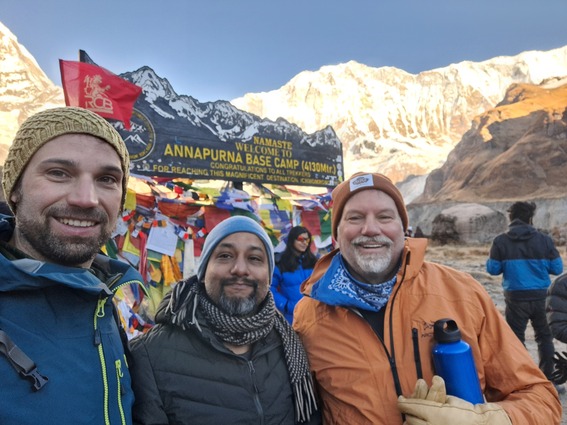
After five days of trekking, covering about 34 miles (55 km) and an estimated 22,600 ft (6,900 m) of cumulative elevation change (all that up and down adds up), the little walk up the hill to our hotel in Pokhara barely registered. Nothing about the hill had changed from before the trek; I just had something new to compare it to.
They say comparison is the thief of joy. It may be, but it can also be the bringer of gratitude and perspective. In the post I wrote before we left, I said that experience changes what you measure things against. This trip has been one long comparison: Nepal against home, and this trip against my last one.
When I compare life in Nepal with life back home, I'm grateful for things I usually never think about, like hot water and electricity that are always there. And when I compare this trip with my 20-month walkabout, I notice how much easier traveling has gotten. Last time I haggled with every taxi; now I tap InDrive and a car shows up at the door, the price already settled. Last time I had little money and took local buses from town to town (when I wasn't hitchhiking); now we can afford bougie private rides. Last time I had to take all my belongings into the bathroom with me; now I just ask Tony to watch my bags.
Back to the Annapurnas
The last time I was in Nepal I also trekked in the Annapurna region: fifteen days on the Annapurna Circuit, covering 110–140 miles (180–220 km) and an estimated 60,700–80,400 ft (18,500–24,500 m) of cumulative elevation change. This time it was Annapurna Base Camp, and Tony and Aabhash came with me.
The afternoon before we set out, we went up to Pumdikot, a hilltop above Pokhara where a 108-foot Shiva statue now overlooks Phewa Lake and the Annapurna range. It wasn't there last time; it was finished in 2021.

We'd planned on seven days, but a logistical hiccup cut the first day off. Getting to the trailheads requires a lifted 4x4, and the only one we could catch was headed somewhere other than where we'd planned to start. It was thanks to Aabhash's quick thinking and knowledge of the routes that we got to any trailhead at all that day. Last time I would have had to navigate that myself, and might have been left standing in Pokhara like some tourists were when we pulled away.
Back in 2013, "I spent the first couple days of my trek alone, passing very few people as I journeyed." This time the trail was crowded and the teahouses were packed, mostly with Indian and Nepali travelers extending their Dashain holiday, with the occasional group of French, German, or English-speaking trekkers. Aabhash was indispensable for getting us beds, and even so, one night we had to hike an extra three hours to reach a camp that still had space in a shared room. Last time I was in Nepal I marveled that you could get wifi at Everest Base Camp. This trek had 4G the whole way up, and plenty of trekkers were on calls while they walked and on social media when they stopped (and sometimes while they walked).
Trekking in the Himalayas isn't quite like hiking other mountains. It's "teahouse trekking": you walk from lodge to lodge, and all the food and lodging has already been carried up for you, by mules for the first teahouse or two and by porters for the rest. Many trekkers hire porters to carry their gear as well. The porters were incredible, running up and down the mountain in flip-flops or cheap tennis shoes with full propane tanks, cases of beer, four backpacks strapped together, or whole tables on their backs. In 2013 I wrote that with enough money you could take a helicopter to the high points. This time six or seven helicopters flew up the valley every day. I think (and hope) most of them were sightseeing flights rather than medevacs.
Why climb?
Why do people climb mountains? Is it just to reach the top and see the view? That's the refrain of the song I've paired with this post, and the question kept going through my mind on the trail. For some reason every peak I see calls me to climb it, and the crazier the peak, the louder the call. I genuinely enjoy the view. But if the view is the point, why not hand your pack to a porter, or take the helicopter if you can afford it?
I've been thinking a lot about convenience lately, and I've come to the conclusion that it isn't necessarily a vice. I'll happily tap InDrive instead of haggling over a taxi. If I couldn't carry my pack, I'd pay a porter. Convenience seems most valuable when it clears space for the difficulties you actually choose, and the climb is one I choose: part of why I climb mountains is to test my edges. Aabhash, Tony, and I all carried our own packs, and I think the weight is part of the point: it's what made reaching Annapurna Base Camp feel like something. As Thomas Paine put it, "What we obtain too cheap, we esteem too lightly."
Last time I wrote that "it's not about just getting to the top"; it's about the journey. Back then I carried a 24-box of Snickers, portable speakers, juggling balls, frisbees, and a whole lot more. This time I carried a 1,000-page book, the tile-based board game Hive, a deck of cards, and plenty of snacks. But compared to the porters, my backpack was empty.
Last time I also wrote that "meeting people is part of the fun of hiking in the Himalayas." This time I felt more introverted, but Tony was a big hit with the other trekkers and made friends all along the way. One group he dubbed "The Crew from Kathmandu" chain-smoked their way to the top (I was surprised how many Nepali trekkers smoked). Even without cigarettes, we were short of breath on the final pre-dawn climb to Annapurna Base Camp to watch the sun rise over the mountains. I honestly thought the moonset over the mountains while hiking up at 5am was even more spectacular than the sunrise. The moon was nearly full, and it was so bright up there that I could hike up the uneven rocks without a light.
I have to give immense credit to my 66-year-old father for being such a beast and a trooper. He humbly describes himself as "overweight and out of shape," and the thinner the air got, the fewer steps he took between breaks and the longer he rested, but he still reached the top in time for sunrise. Aabhash nobly set out early with him to keep him company (and safe), while I slept in a little and raced to catch up. In 2013, lost in a snowstorm near the top of a mountain, I thought, "My dad will be so mad if I die like this." This time the thought was closer to, "I'll be so mad if my dad dies like this."
We pushed hard every day after that, hustling to get off the mountain a day early, ahead of the storms Cyclone Arnab sent our way. They dropped 4.4 ft (1.35 m) of snow around Tilicho Lake, where I got lost in a snowstorm in 2013, and left hundreds of trekkers stranded in high-altitude lodges.
Greener grass
Back in Pokhara, Aabhash sadly had to head home. I feel so lucky to have spent three weeks with him: two with his family at home, and one in the mountains with just him and my dad. Tony and I stayed put to wait out the storm rather than heading straight back into the mountains for a second trek, as we had initially planned.
One night we went out with The Crew from Kathmandu, who were also recovering before heading home. Once again the conversation turned to traditional versus modern family life, and all of them seemed to favor modern. Half of them live outside Nepal, in Canada, Australia, and the U.S., which seems very common these days. A lot of the people we met had also lived in Dubai at some point, but that seemed to be purely for work; the ones who'd moved to "the West" seemed to be looking for a different way of life.
That's the other side of comparison, the side that steals joy. They look West and see freedom; I look at Aabhash's house and see a family where everyone looks out for each other. I see community and support. The grass is always greener. I still think something in the middle is probably ideal: some family, some freedom. Local autonomy but accountability to the whole.
I'd love for there to be a clean rule here: this comparison is good, that one is bad. But I don't think the world works that way. The Crew from Kathmandu and I were making the same comparison from opposite ends. Like everything else, the value of comparison seems to be in how you use it. When I use it to ask what a difference can teach me, it gives. When it turns into a verdict on whose life is better or what mine is missing, it takes.
After a few days in Pokhara watching what the storms did to the trails and roads, it became clear we'd all picked up a bit of a cold in the mountains. Rather than fight the crowds and stress our immune systems on another grueling trek, Tony and I changed plans and started heading south. Our first stop was Bandipur, a charming, quiet, traditional Newari hilltop town with a spectacular view of the Himalayas, and a perfect place to rest for a couple of nights before continuing south to Chitwan, Nepal's most famous national park for rhinos and tigers. Last time I skipped it for Bardia, far out in the west, where "I got the feeling I was the only tourist in the entire park." I'll be curious to see how this one compares.
P.S. If you read these posts by email, you might not know the site also has a photo gallery. There are lots more photos from this leg of the trip: the trek up, the Annapurna Sanctuary, the trek down, Pumdikot, and Bandipur.
Soundtrack: The Mountain Song (Tophouse)